Local server, zero lag
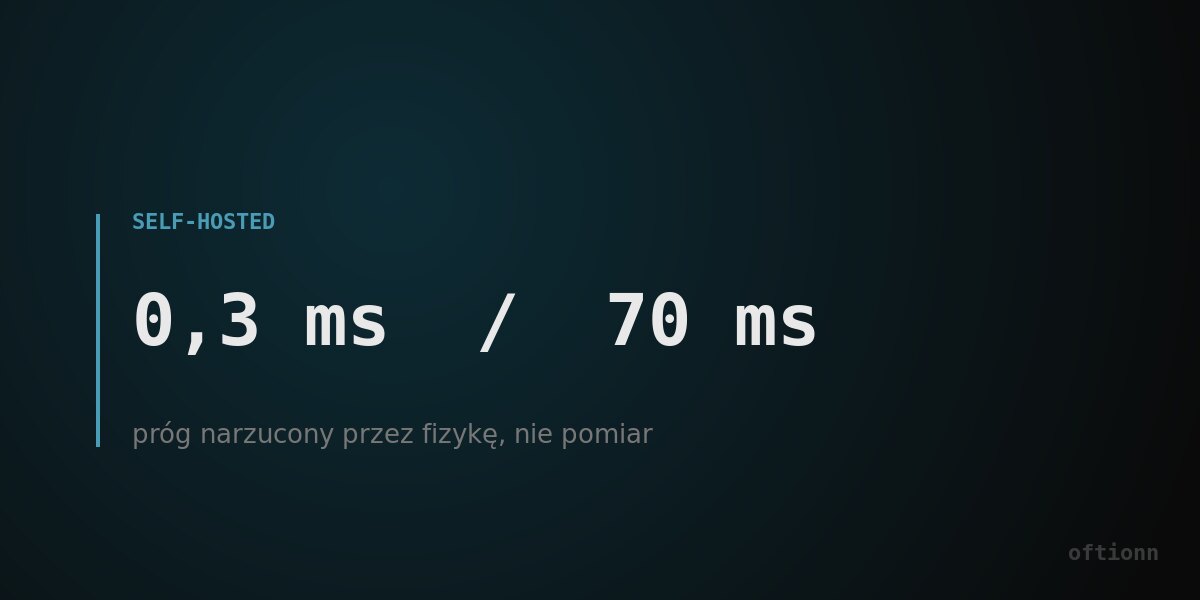
One millisecond from the next room against 150 from the other side of the Atlantic.
Open a file from a server in the next room and it appears. Open the same file from a server on another continent and it also appears — a moment later. Both are fast. Only one of them feels like the file is yours, and the difference between those two sensations is a number most people have never been shown.
The number is latency: how long a signal takes to get there and back. Not how much data fits through the connection — that is bandwidth, and people conflate the two constantly. Bandwidth is the width of the pipe. Latency is the length of it, and no amount of widening makes a pipe shorter.
Why distance has a floor you cannot buy your way past
Light in a fibre travels at roughly two thirds of its speed in vacuum. That gives you a bit over two hundred kilometres per millisecond, and the signal has to come back — so roughly one millisecond for every hundred kilometres of distance, there and back, in the best imaginable case.
That is the floor set by physics, before any equipment is involved. Warsaw to Frankfurt is about nine hundred kilometres, so it cannot be faster than roughly nine milliseconds. Warsaw to the east coast of the United States is about six thousand eight hundred, so it cannot be faster than about seventy. Reality adds to that generously — cables do not run in straight lines, and every router along the way costs time — so the numbers you actually measure are higher, often two or three times.
A machine in the next room, on a wired local network, answers in well under a millisecond. That is not an improvement on seventy; it is a different category, and it is the only part of this comparison that cannot be changed by anybody's investment in infrastructure.
Where tens of milliseconds become seconds
Seventy milliseconds is nothing. Nobody perceives seventy milliseconds. So why does the distant server feel different?
Because operations are rarely one exchange. Opening a document is a conversation: establish a connection, authenticate, ask for metadata, request the file, acknowledge, close. Each step waits for the previous one. Ten round trips at seventy milliseconds is most of a second before anything appears — and ten is a modest estimate for anything involving a login.
Now do that for every thumbnail in a folder of four hundred photographs, and the difference stops being subtle. This is the specific reason browsing a large remote photo library feels sluggish while streaming a film from the same service is flawless: the film is one long transfer where bandwidth rules, and the folder is thousands of small exchanges where latency rules.
The same asymmetry shows up in the work I do professionally. A query against a database in the same building returns while you are still looking at the screen. The same query against a database across an ocean, if it is written as a loop making many small requests rather than one large one, can take minutes. The query is identical. The distance did that.
The honest limits of this argument
I have to be careful here, because this is the point where an article like this normally overreaches.
Latency only helps you when you are near the server. A local machine is instant at home and no better than anything else when you are working from a hotel in another country — at that point you are crossing the same distance as everyone else, plus your home connection's upload speed becomes the constraint, and domestic upload is usually much slower than download. For someone genuinely mobile most of the time, a well-placed hosted service will beat a server sitting in their empty flat.
Large providers also do something a home server cannot: they put copies close to everybody. Content delivery networks exist precisely to defeat this problem, and they defeat it well. For serving the same file to many people in many places, distributed hosting wins and it is not close.
So the honest claim is narrow: for people working where their data is, with many small files, local hardware is in a category that no subscription can reach — not because of engineering quality, but because of the speed of light. And most small companies are precisely that case. The office is where the work happens and where the files are, and that coincidence is worth more than it usually gets credit for.
There is also a failure mode worth naming, because it is the one clients actually notice. A local server keeps working when the internet does not. Not faster — working. A broken connection at the provider means a company with hosted files cannot open a document, and a company with a machine in the corner carries on and finds out about the outage from the news.
If you want to see the number for yourself, it takes thirty seconds. Ping something in your own house, ping something in your own country, ping something on another continent. Three figures, one evening, and you will never again read "the cloud is just as fast" without asking which part of fast is meant.
Prefer not to build it yourself?
We ship NAS servers and Dells with this whole stack preinstalled — Nextcloud, Immich, Jellyfin, Stirling PDF, n8n and Home Assistant, configured before shipping. You plug in power and network. The AI and the automation you can click through online right now.